
RECENT MEDIA ABOUT DAVID
The time has come for more people with scientific expertise to hold government office, Sanders says. “I feel as if most of the issues that face society have a scientific or technological basis.” Granted, he says, these won’t all necessarily have a scientific solution. “But it's important to understand these issues on a firsthand basis and not rely on lobbyists on one side or another to help you determine how to think about the issues.”
Sanders says the concerns he hears most often in his door-to-door campaigning involves data centers, carbon sequestration, water, and surveillance technologies. All these topics have a foundation in science and technology, he says.
Protecting Academic Freedom
The Indiana legislature also recently enacted S.B. 202, which requires colleges and universities to create a process for students to report professors who don’t present all sides of an issue they discuss in class. It also implements a 5-year review system for tenured professors. The bill was authored by Deery, Sanders’s opponent in the upcoming election. The law strongly infringes on academic freedom, according to Sanders. “It's supposed to be about intellectual diversity,” he says. “It's actually imposed ideological diversity.”
Science in Service of the Community
These scenarios show how having a scientist lawmaker could be extremely valuable, “because we face these kinds of challenges all the time,” Sanders says.
“I'm not saying everybody in the Indiana state legislature needs to be a scientist,” he says, “but it would be nice to have one.”
David Founded Stop the Water Steal
“About 18 different jurisdictions, Republican and Democratic alike, thought this was a terrible idea,” Sanders says. Along with others in the Wabash Valley, Sanders founded an organization called Stop the Water Steal to oppose the pipeline. After consulting with water experts at Purdue, Sanders was able to provide information about how the pipeline would negatively affect the river’s chemistry and hydrogeology. After multiple towns and counties passed formal resolutions opposing the pipeline, it was called off. “We fought it with science,” Sanders says.
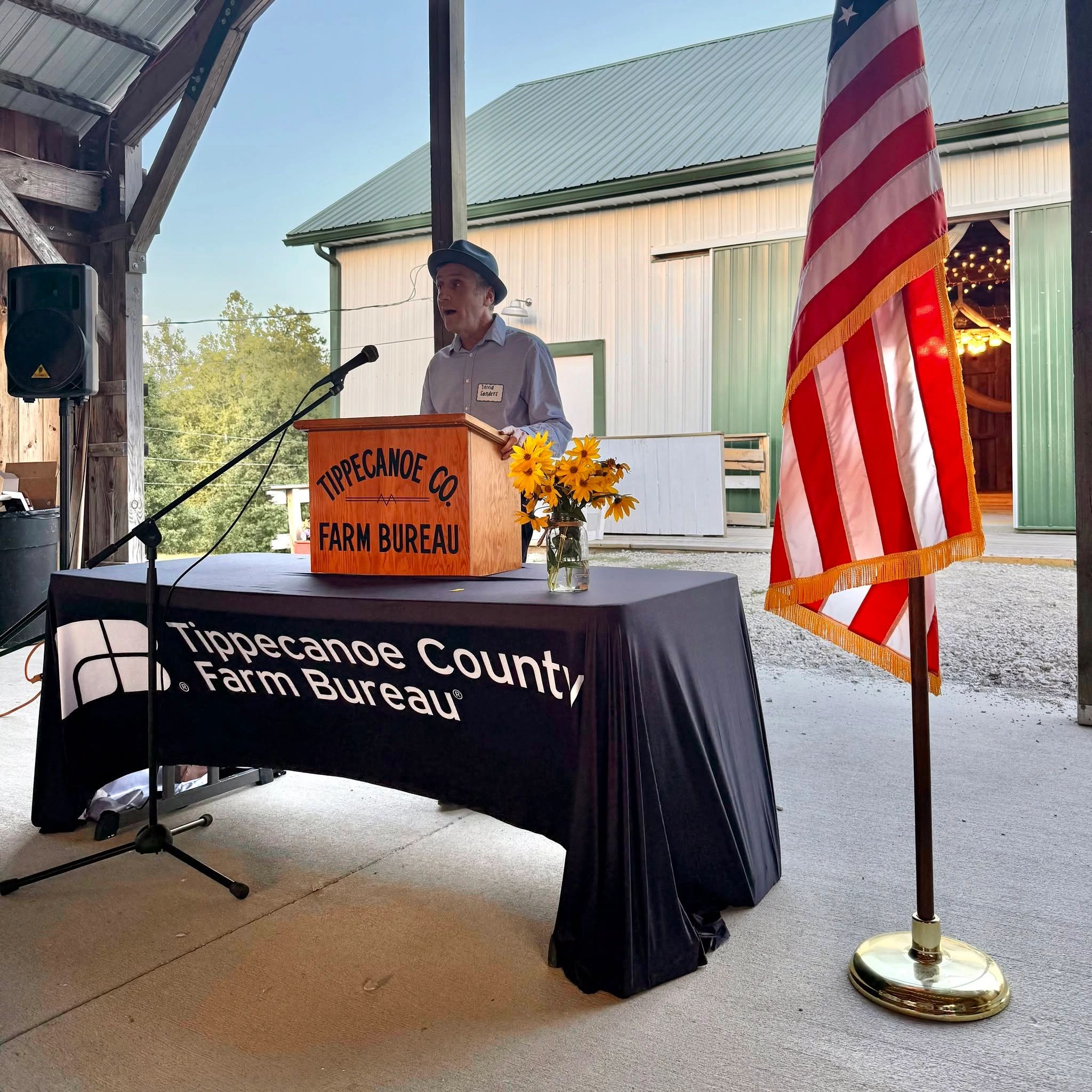
Greater Lafayette candidates meet with local voters, share goals
David Sanders, the Democratic candidate for Indiana State Senate District 23 and founder of Stop the Water Steal, discussed data centers and carbon sequestration, as well as his concerns about water policy during his time on the podium.
Bringing Communities Together
Sanders, who has lived in West Lafayette for over 30 years and who serves as West Lafayette city councilor, said his approach is to bring people together around shared goals rather than divide them along party lines.
“I am a scientist,” Sanders said.
The Future of Agriculture
He believes scientific expertise will play in addressing challenges in agriculture and technology in Indiana. He said that agriculture will be significantly transformed by emerging technologies and said having scientific expertise represented in the legislature is important.
Young Voters
Sanders later commented towards the young voters in attendance, saying their vote is important in November.
“You guys have to live with the decisions we make for the longest. If we don't take that into consideration we aren't doing our job,” Sanders said.

Sanders says state law puts ‘muzzle’ on academic speech
Democratic state Senate candidate David Sanders said Indiana’s higher education policies are “placing a muzzle on academic free speech,” making protections for Purdue faculty and local decision-making central to his campaign for District 23.
SB 202 & Suppression of Academic Freedom
His sharpest criticism centered on Senate Bill 202, authored by Republican state Sen. Spencer Deery. The law requires Indiana’s public universities to adopt policies promoting free inquiry, free expression and intellectual diversity while subjecting tenured faculty to periodic reviews.
“It’s eliminated, in essence, tenure protections,” Sanders said. “And it is placing a muzzle on academic free speech.”
Student Diversity
Sanders also connected Purdue’s academic reputation to its international faculty and students. He said reducing students’ exposure to people from different backgrounds would “impoverish the educational experience.”
“We have students and faculty from around the world who look toward Purdue as a superior place to get higher education,” Sanders said.
Stop the Water Steal and Uniting Communities
He said he founded Stop the Water Steal to oppose a proposed transfer of as much as 100 million gallons of water per day from an aquifer connected to the Wabash River to the LEAP Lebanon project. This project aimed to use water from the Wabash watershed to manufacturing facilities for corporations like Eli Lilly. Sanders credited the organization and its allies across the political spectrum with helping halt the proposal.

The Importance of Agriculture to the Future of Indiana
David Sanders, of West Lafayette, focused on constituent concerns regarding the shift of rural property away from farming and toward major development projects.
Data Centers
“People are concerned about data centers,” Sanders said. “People are concerned in Vermillion County about eminent domain and taking their land for carbon sequestration, and I’ve worked with those communities to try to help them organize to defend their own interests.”
Stop the Water Steal
Sanders also highlighted his advocacy against regional water diversions.
“People are very interested in the work that I did on ‘Stop the Water Steal’ to prevent the transfer of 100 million gallons of water from aquifers associated with the Wabash River to the LEAP Lebanon project,” Sanders said.
We Need More Candidate Forums
Sanders echoed the value of grassroots public debate for the community.
“I honestly believe we need more forums like this,” Sanders said. “The fact that the Farm Bureau has consistently hosted these forums is absolutely tremendous and is a great credit to the organization. I really wish there were more of them.”

Letter: Sanders calls for election integrity in Indiana District 23 race
The Indiana Recount Commission decided to award victory to Paula Copenhaver in the Republican primary for Indiana State Senate District 23.
More than four months ago, Copenhaver prematurely declared victory in a race that was not decided until now. It was not a prediction; it was a false statement at the time.
Not only did she, with or without merit, attempt to get votes for the Republican incumbent discarded, but she also wanted to subpoena voters, so that they would have to testify about the contents of their secret ballots, thereby endangering the privacy of our election process. The lawyer for Deery called that attempt “disgusting.”